

Enterprise software development is rapidly accelerating, thanks in no small part to AI-powered coding tools like GitHub Copilot and ChatGPT. While developers now build features two to three times faster, traditional infrastructure processes remain firmly tethered to manual provisioning, IaC scripting, and reactive incident response. This mismatch has become a major bottleneck and Gartner (News - Alert) estimates that, by 2028, AI will execute at least 15% of day-to-day infrastructure tasks, up from essentially zero last year. Still, today, manual and semi-automated infrastructure remains the norm resulting in developers spending time on infrastructure provisioning – time they could be spending on building features – and it costs firms billions.
At the same time, enterprises face escalating demands around security, compliance (e.g. HIPAA, Fed RAMP, and MARS-E), cost efficiency, and reliability. These pressures make full autonomy challenging. What’s needed now is not simple automation, but agented infrastructure – systems that understand organizational intent, enforce policies, self-heal, and continuously optimize themselves.
"While AI transforms every aspect of business, infrastructure teams remain stuck with manual processes that can't keep pace with AI-accelerated development,” said Sachin Agarwal (News - Alert), CEO of StackGen.
So, that’s exactly what StackGen is looking to overcome with its new Autonomous Infrastructure Platform, which features a range of next-gen AI agents – StackBuilder, StackGuard, StackHealer, StackAnchor, StackOptimizer, StackScribe, and StackFinder. These AI agents replicate the full operational lifecycle of cloud infrastructure, including building, governing, healing, and optimizing.
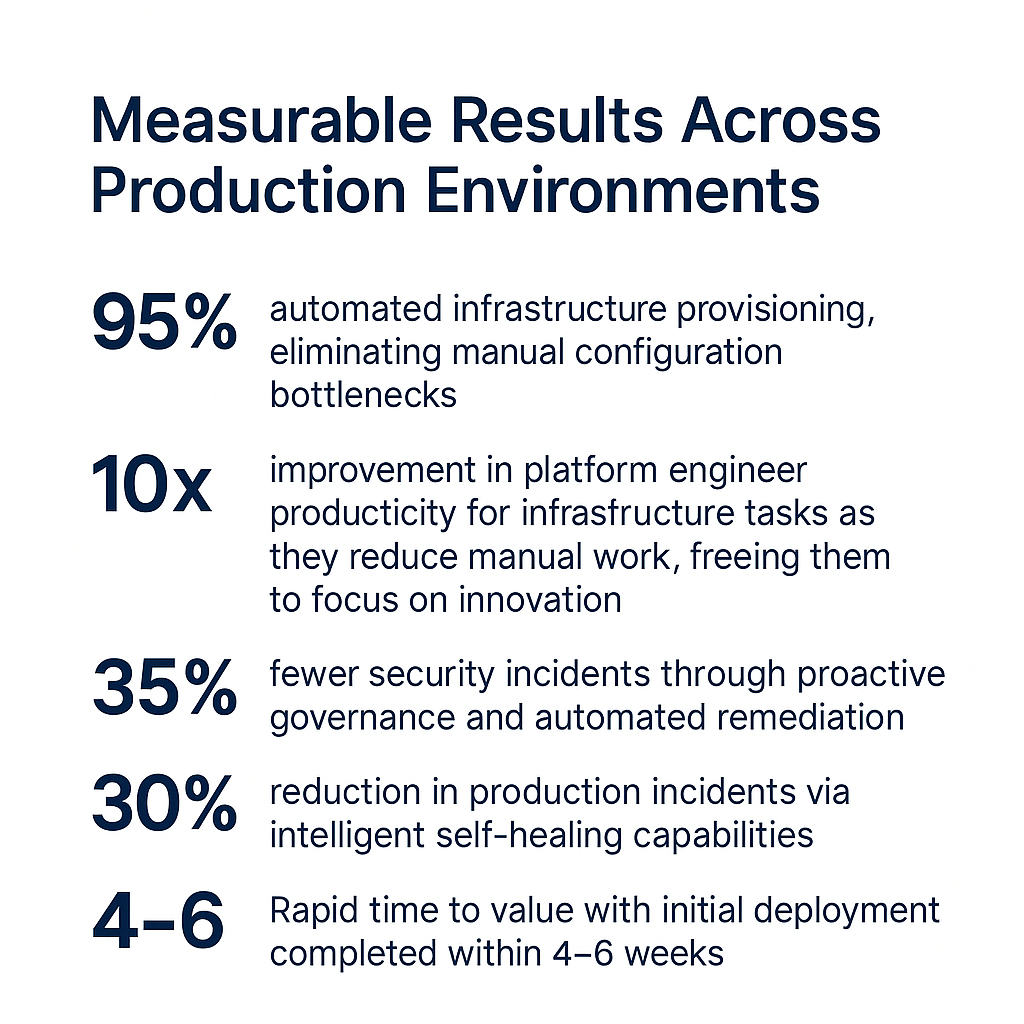
- StackBuilder – Generates compliant IaC code automatically from developer intent, eliminating 95% of manual provisioning.
- StackGuard – Enforces governance and compliance continuously.
- StackHealer and StackAnchor – Handle incident remediation and drift management, cutting mean time to resolution to under five minutes.
- StackOptimizer – Analyzes cost and performance, suggesting or triggering configuration changes on the fly.
- StackScribe – Learns from interactions to improve future decision-making.
- StackFinder – Discovers and onboard existing environments.
The entire agentic system sits atop StackGen’s deterministic Infrastructure-as-Code foundation and integrates with existing ecosystems (Terraform, AWS/Azure/GCP, GitLab, Snowflake, Kubernetes, identity services, etc.).
This could be a game-changing, evolutionary moment, taking cloud infrastructure from AI-augmented to fully AI-managed agentic infrastructure operations: Traditional IaC centered on scripts; generative AI eased writing them.; and, now, agented AI removes the need for scripts entirely—agents interpret intent and act.
StackGen’s multi-agent architecture reflects architectural best practices emerging in agentic AI research. Its agents are specialized by function, coordinated via a control plane, grounded in context, guided by organizational knowledge, yet capable of dynamic reasoning and optimization.
StackGen’s Autonomous Infrastructure Platform has a range of implications for enterprises, starting with eliminating the infrastructure bottleneck and bringing scale and speed onto a level playing field. Developers define intent and AI agents provide production-ready environments within hours instead of weeks.
Importantly, governance is not lost, as compliance and security are baked in, not bolted on, reducing drift, avoiding outages, and protecting against policy violations.
In addition, the system delivers the resilience and efficiency enterprises need, with self-healing agents handling incidents proactively, shifting operations from reactive repair work to real-time remediation. Agents also optimize cost and performance dynamically, maintaining minimal operational overhead.
Initial rollout begins with early access to StackBuilder and StackHealer in Q3 2025, with full lifecycle autonomy expected by 2026. StackGen says early adopters like Autodesk (News - Alert), SAP NS2, and the NBA are already seeing significant results from their AI agents.
As agentic AI becomes the standard across domains, infrastructure is emerging as the next frontier. To take advantage of this latest agentic AI trend, organizations need to:
- Map AI-driven workflows to infrastructure processes and identify where intent-to-infrastructure pipelines make the most impact.
- Adopt early agentic platforms (like StackGen) to test pilot projects in lower-risk environments.
- Define governance and “silver path” policies, enabling agents to enforce compliance consistently.
- Iterate rapidly using platforms that learn and improve over time (e.g., agents like StackScribe that refine decisions based on usage).
- Prepare for role transitions by upskilling DevOps and platform engineers to orchestrate agents rather than manually craft pipelines.
StackGen’s Autonomous Infrastructure Platform signals that agentic AI is no longer a speculative concept. Rather, it’s a reality that is reshaping DevOps and infrastructure management. By eliminating legacy friction, injecting governance into the flow, and empowering engineers to focus on innovation rather than configuration, agentic infrastructure represents the evolution enterprises need to stay competitive. The era of reactive infrastructure is ending and autonomous, intent-driven systems are here, and early adopters are already reaping the benefits.
Initial rollout begins with early access to StackBuilder and StackHealer in Q3 2025, with full lifecycle autonomy expected by 2026. StackGen says early adopters like Autodesk, SAP (News - Alert) NS2, and the NBA are already seeing 10× productivity gains for platform engineers, 35% fewer security incidents, and provisioning cycles slashed to 4–6 weeks.
Learn more about how agentic AI is improving business processes and operations across industries at AI Agent Event, taking place September 29-30 in Herndon, Virginia, in the Washington, D.C. metro area. The conference program includes speakers from leading companies like Lockheed Martin, AWX, Cisco (News - Alert), and others, who will address key themes and offer success strategies for AI agent adoption.